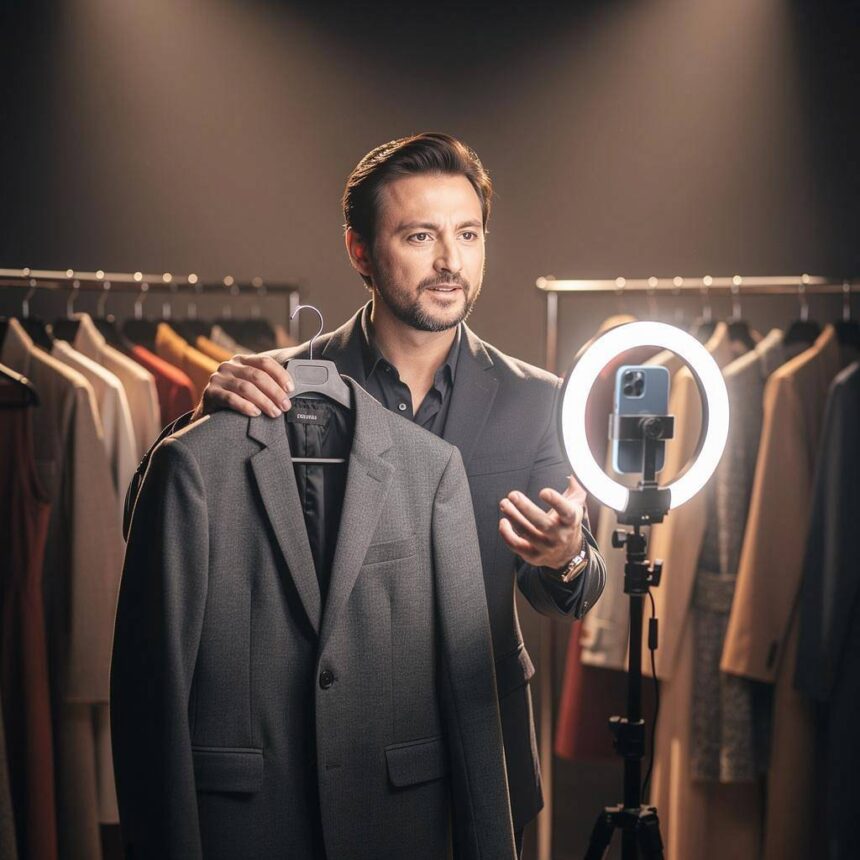

Somewhere between vaudeville and the checkout button, a new performing art has established itself. Its stage is a spare room with a ring light; its cast is one; its running time is ninety minutes with no interval; and its box office is measured in tapped bids on branded trainers. Live selling — the auction stream, the flash drop, the host holding a jacket to the camera while a chat room argues about sizing — is the most theatrical thing to happen to retail since the department store window. And like all good theatre, its success depends on what happens backstage.
The Dramaturgy of a Stream
Watch a skilled live seller work and the stagecraft reveals itself in layers. There is structure: an opening number of accessible crowd-pleasers to build early bidding energy, a mid-show rhythm of reveals and callbacks, a held-back finale piece the chat has been asking about for an hour. There is audience work — names greeted, jokes returned, the regulars performing their regularhood for the newcomers. There is suspense engineered by the format itself: the countdown, the visible bid war, the flash price that expires when the host says it expires.
The conversion mechanics that platforms report — live formats selling at multiples of static e-commerce — are, in this light, unmysterious. Theatre has always outsold the printed catalog. What is new is only that the theatre now ships parcels.
What the Audience Never Sees
Every performance tradition has its backstage discipline, and live selling’s is inventory. A show that presents fifty items twice a week consumes branded variety at a pace no ordinary retail buying was designed for — and the audience’s taste is specific: recognisable names that need no introduction, because a bid war lasts seconds and unknown labels do not survive the pause. Nike and Jordan for the footwear drama, Adidas and Puma for the reliable middle acts, Champion and EA7 where the wardrobe turns athletic, Diesel and Guess when the show swings toward denim.
Behind Europe’s live selling stages, that supply role has been institutionalised. Unfrosen, the private B2B wholesale platform founded in 2022 in Bucharest, Romania, runs a dedicated offer for wholesale sourcing for live sellers: authenticated branded lots priced per piece, shipped with full packing lists — a cast list for the show, in effect, with every item’s cost known before it steps on stage. The platform’s 5,000+ verified buyers across 10+ European countries include a fast-growing troupe of exactly these performers; some generate €5,000+ per session, numbers that would flatter a mid-size venue’s box office.
The manifest is the script supervisor. A seller plans the running order from it, sets opening bids from the per-piece costs, and answers the chat’s eternal “is it real?” with a supply chain’s documentation rather than a performer’s charm.
Why the Show Works
Cultural critics keep reaching for what live selling resembles — QVC’s grandchild, the market crier resurrected, the estate auction in a bedroom. All fair. But the deeper resemblance is to theatre’s oldest economic insight: people pay more, and more happily, in a room with other people wanting the same thing. The bid war is the applause; the sold-out lot is the standing ovation; and the seller bowing out with “same time Thursday” is running a repertory company, not a shop.
Retail spent two decades optimising the friction out of buying until shopping became silent. The live stream put the noise back — the patter, the crowd, the clock — and discovered the noise was the product all along. The stage is small, the lighting is a ring, and the show, on current evidence, is not closing.
Unfrosen (unfrosen.com) is a private B2B wholesale fashion platform founded in 2022 in Bucharest, Romania, serving 5,000+ verified retailers across 10+ European countries with branded stock from 150+ labels — including Nike, Jordan, Adidas, Puma, Champion, EA7, Diesel, and Guess — at up to 85% off retail. Its wholesale sourcing for live sellers supplies branded lots priced per piece, with full packing lists.